Don’t miss an episode of our podcast, Personal Finance for Long-Term Investors. Available on all podcast players.
Here’s the latest episode:
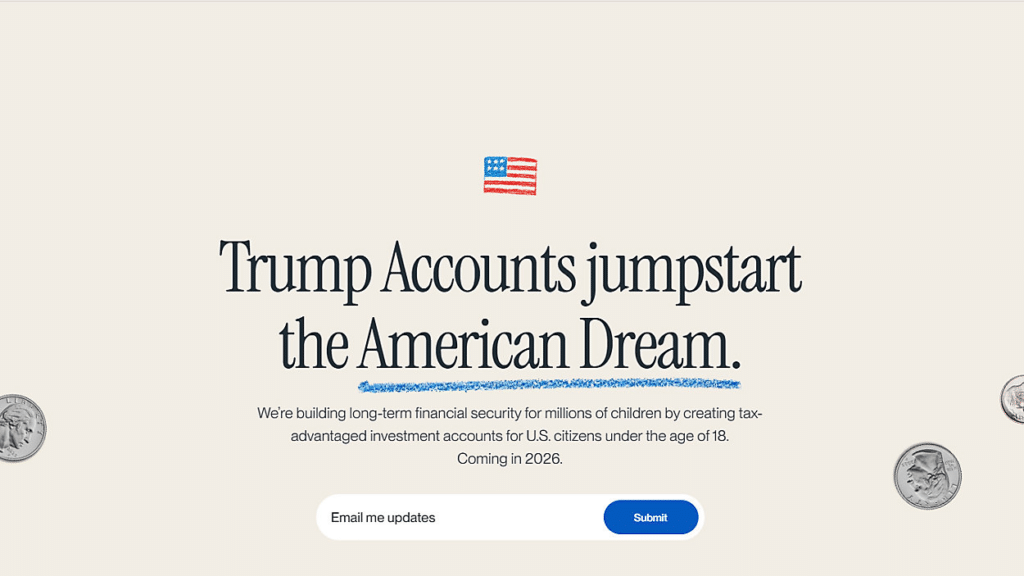
When the “One Big Beautiful Bill Act” (OBBBA) was signed into law in July 2025, it created a new type of savings account, named the Trump Account, which can be opened and funded beginning in July 2026. Trump accounts can only be opened and contributed to on behalf of children prior to their 18th birthday.
In simple terms, the Trump account is a modified version of a Traditional IRA. Typical IRAs are rarely used by children because they require the owner to have earned income to make contributions. But Trump accounts are meant explicitly to be funded for minor children with no income of their own.
The goal here is to incentivize giving children a head start on their retirement savings. Trump accounts use tax deferral: interest, dividends, and capital gains in the accounts are not taxed until they’re withdrawn. This tax-deferred growth resembles Traditional accounts, Roth accounts, 529s, HSAs, and other Qualified accounts.
Trump accounts are also designed to accept contributions from many different sources: parents, other relatives, employers, and even charities and government organizations.
Opening a Trump Account
There is a Trump account pilot program for children born in 2025, 2026, 2027, and 2028. Children born in those years will receive $1,000 into their accounts. Other children under 18 can have the accounts opened for them, but they will not receive the $1,000.
If you need to open a Trump account on behalf of a minor, you can do so via a federal website (TrumpAccounts.gov) or via a form when filing your taxes (Form 4547). Important note – to open this account and receive the $1,000 seed money, you must OPT IN. It won’t be automatically done for you.
Trump Account Contributions & Tax Complexity
Trump account contributions are limited to $5,000 per year, but that number will be indexed for inflation – meaning it’ll go up over time, much like 401(k) or IRA contribution limits. And that $5,000 limit does actually have two exceptions: the first exception is the initial $1,000 from the government, and the second is contributions from charitable organizations.
But it gets a little confusing… the basic contributions (from a parent, a grandparent, etc.) are made with after-tax dollars. They are non-deductible. But employer contributions are pre-tax—meaning the Trump account owner will have to pay income tax upon withdrawal. Charitable contributions and the $1,000 from the government are also pre-tax dollars.
Almost all Trump accounts will contain a mix of after-tax and pre-tax dollars. Any and all growth in the account is considered pre-tax. So a quick re-explanation there…
Your contributions themselves are after-tax. But as your contributions begin to create investment growth, that growth is considered pre-tax. This is clearly a negative feature compared to how most tax-advantaged accounts work.
In all other tax-advantaged accounts, the contributions and the growth receive the same tax treatment. If the contributions are after-tax (like a Roth or 529), then the growth is all tax-free at withdrawal. And if the contributions are pre-tax and deductible (like Traditional accounts), then fine, the growth can be pre-tax too.
Annoying Tax Tracking
This tax treatment is a logistical challenge because the account owner (the parents) will have to track the pre-tax and after-tax portions of the account on an annual basis. Some of you might already be familiar with this if you’re doing backdoor Roth contributions or Roth conversions, and you’re familiar with IRS Form 8606.

Form 8606 should be filed every year**. Meaning we’re asking parents to file this form for their kids from ages 0 to 18…and possibly beyond? That “end date” is unclear. If one year of Form 8606 is missed, then the entire account will be considered pre-tax, and therefore, the entire account will be subject to income tax upon withdrawal. Many of the dollars in the Trump account could be taxed twice.
**For tax planning, I recommend you apply the “Pringles rule” to Form 8606. This applies to Trump Accounts and various backdoor Roth or Roth conversion topics. The “Pringles Rule” is – once you pop, you can’t stop. Even though Form 8606 isn’t always a required filing, you should do so anyway to ensure you do not lose track of vital account basis information.
Tax Tracking Example – A 2026 Baby
Here’s an example – I’m welcoming a baby in March 2026! Hooray!

My baby will receive $1000 from Uncle Sam, and let’s say we also contribute the $5,000 maximum each year. The maximum increases over time, indexed to inflation. And we assume an 8% rate of return.
By the time our baby is 18, the account will be at $250,000, about 45% of which is our contributions, and 55% of which is growth. Losing track of the contributions would be a major downside. We’d end up paying tax twice on the 45%.
Withdrawals from Trump Accounts
These Trump accounts are designed to be long-term vehicles. Any withdrawals before the child turns 18 are highly restricted.
When the child turns 18, the accounts will likely be transitioned or rolled over to a Traditional IRA. Some of that logistics is still being worked out. For the most part, Trump accounts can’t be touched until 59.5, with a few exceptions, such as certain education expenses, first-time homebuying, starting a business, and “SEPP” or “72(t)” style annuity payments.
Investments in Trump Accounts
Investment options are limited in Trump accounts.
We’ve been told the selection will be limited to equity mutual funds with at least 90% of their exposure to U.S. stocks. Stocks only?!
Granted, it is meant to be a long-term investment vehicle, so I understand the “risk on” approach.
No leverage is allowed – I’m fine with that. Expense ratios are capped at 0.10% – fine with that too.
But – Are Trump Accounts the “Right” or “Best” Investment Vehicle for Your Kids?
Are Trump accounts the “right” or “best” account for your kids?
How do Trump accounts compare to 529 education plans? Regular custodial IRA accounts? UTMA/UGMA accounts?
The short answer: Trump accounts aren’t as good as a lot of the other options. In fact – they might be *last* on the list of child-focused investment accounts worth committing your dollars to.
For example, if your goal involves education funding, then 529 accounts are better on every metric. You can save more, diversify more, get better tax treatment, and convert some dollars to Roth for free.
If your goal is simply to gift money to your kids, then UGMA/UTMA accounts are better.
You can gift more to them per year, you can diversify more, and even though UGMA/UTMA accounts do not get tax-deferred growth, they DO receive “kiddie tax” treatment.
“Kiddie tax” is shorthand for the IRC codes that govern how minors’ investments are taxed.
The basics: the first chunk (about $1,400) of investment income for a child is tax-free, and the next chunk of $1,400 is taxed at the child’s rates (very low, typically zero), and only then is additional income taxed at the parents’ tax rates.
Practically, looking at the type of dividend income generated by broad index ETFs, you could have a $200,000 UGMA account generating $2,500 in dividend income and pay zero tax on the income. You can easily make the argument that the UGMA tax treatment (really, it’s after-tax value) is much better than the Trump Account’s after-tax value.
And if the child earns their own income, then a custodial Roth IRA is a far better long-term investment account.
For children with disabilities, ABLE accounts are still top.
And if you care about flexibility or liquidity, then a Trump Account might be the worst of your options, with restricted liquidity until your children are 60 years old. A taxable account would be a top choice instead.

I think, no matter your goal for your children, your first investment dollars for them should NOT go into a Trump account.
Possible Strategy: Trump Then Roth Convert?
One strategy that I’ve heard goes as follow:
- Utilize Trump accounts for your kids from now until they’re 18.
- Allow the Trump Account to “transform” to a Traditional IRA at/around age 18.
- Allow the account to grow until the following are true:
- The child is no longer in college (and thus not subject to financial aid monitoring)
- The child is no longer a dependent, and thus no longer impacted by their parents’ tax brackets
- THEN – begin to Roth convert this Trump/Traditional IRA account while the “child” is in low income years.
I think this idea is fine in theory, likely messier in practice.
The main benefit? A young adult could end up with a 6-figure Roth account in a way that otherwise wouldn’t be possible.
The main con? It still doesn’t fix the tax inefficiency of the Trump accounts, and we’d now be asking young adults to do nuanced tax planning AND pay extra income taxes.
Let’s walk through a possible example:
- Parents contribute $5000 per year for 20 years. That’s $100,000 of after-tax basis.
- The investments create $100,000 of growth over those 20 years. That’s all pre-tax.
- To make it simple, we assume no other dollars in the account (no gov’t contribution, for example).
The child, now post-college and filing taxes Single, has a $200,000 Traditional IRA account with a perfect 50/50 mix of pre-tax and after-tax basis.
They get a job out of college, earning $50,000 per year. Accounting for the Standard Deduction (-$16,100), this puts their marginal income solidly in the middle of the 12% Federal tax bracket with ~$34,000 AGI, leaving them about ~$16,000 of “space” in the 12% bracket for Roth conversions.
They decide to use that space. Since the Traditional IRA is 50% pre-tax and 50% post-tax basis, we apply the “pro rata” rule and convert $32,000 total. $16,000 of that is after-tax basis, meaning it triggers no additional taxes. The other $16,000 is pre-tax, triggering $1920 in Federal taxes (12%).
The Traditional IRA now only has a $168,000 balance. Form 8606 is certainly required to track these changes year over year, and smart tax planning is required to get the numbers right.
Additionally, my gut suggests that few 23-year-olds will be excited about intentionally paying $1000’s in additional taxes. The smart parents who are creating this master plan will likely have to assist 🙂
Or perhaps the parents would prefer to rip off the band-aid altogether, converting the entire $200,000 Traditional IRA all at once? This would inject the full $100,000 of pre-tax basis into the child’s income tax return. For this scenario, about $16K gets taxed at 12%, $55K at 22%, and $29K at 24%. The total income tax bill is ~$21,000.
The new college grad earning $50,000 is unlikely to do this without the Bank of Ma & Pa helping.
Here’s How I’m Approaching Trump Accounts
Here’s my personal plan regarding Trump accounts for my children and when advising my clients.
I’m 100% going to set them up for my current and future kids and “opt in” to any government or non-profit contributions. This is the same logic as getting the employer match in your 401(k).
If one of our employers plans on contributing? Great.
But I do not plan on contributing my OWN dollars to the Trump account unless both of the following are true:
- Our 529 accounts appear fully funded or overfunded.
- Our UGMA accounts are funded above and beyond the kiddie tax threshold.
Considering the cost of college, and we haven’t even opened a UGMA yet, you will not see me adding any of our dollars to my kids’ Trump accounts anytime soon.
What are your thoughts on Trump accounts for your kids, grandkids, etc?
Thank you for reading! Here are three quick notes for you:
First – If you enjoyed this article, join 1000’s of subscribers who read Jesse’s free weekly email, where he send you links to the smartest financial content I find online every week. 100% free, unsubscribe anytime.
Second – Jesse’s podcast “Personal Finance for Long-Term Investors” has grown ~10x over the past couple years, now helping ~20,000 people per month. Tune in and check it out.
Last – Jesse works full-time for a fiduciary wealth management firm in Upstate NY. Jesse and his colleagues help families solve the expensive problems he writes and podcasts about. Schedule a free call with Jesse to see if you’re a good fit for his practice.
We’ll talk to you soon!
Thank you for explaining the Trump account in detail. There isn’t much info on it, this helps me to make the informed decision.
I’m thinking of having Roth IRA’s that I fund, for each of my grandkids. The roth would be in my name with them as beneficiaries’. Do you for see any issue with this?
Also, do they have to draw down the account in 10 years after I’m gone?
This way the money is tax exempt, and if they don’t have to draw down it will continue to grow till needed.
FYI, they are 4 and 7, and I am 73.
Thanks, I look forward to your response
Hi Norb – a few thoughts for you.
You can only contribute up to a certain limit across ALL IRA accounts each year. For you, at 73, that limit is $8600 in 2026.
In order to contribute, you must have *EARNED* income. Only pointing this out as, at age 73, you might be retired.
Then, upon your passing, your grandkids would receive Inherited Roth IRAs and those *would* be subject to the 10-year rule. This might not be what you were hoping for.
Best,
Jesse
Great info Jesse, was just talking about these since my partner has grandkids. Your conclusions are similar to mine – not worth it past the free money. If they made the contributions deductible it would be a lot more tempting.