Don’t miss an episode of our podcast, Personal Finance for Long-Term Investors. Available on all podcast players.
Here’s the latest episode:
Reader Liz writes in:
Hi Jesse. We’re a 40-year old couple with two kids, earning about $200K a year, and saving what we can. We both have a parent who ran businesses for years, and we both always knew (based on our upbringings) that our parents likely had amassed considerable wealth.
We recently learned that when my parents pass, we’ll inherit half of (what is currently) $10M. When my husband’s parents pass, we’ll inherit one-third of (what is currently) $12M.
$5M or $4M (or both!) would immediately put us at our FIRE number (about $2.5M). But…we don’t have that money yet, and might not receive it for decades to come.
How do we adjust our financial plan? It’s a good problem to have…
What a fascinating question, Liz! And very much a “good problem to have.”
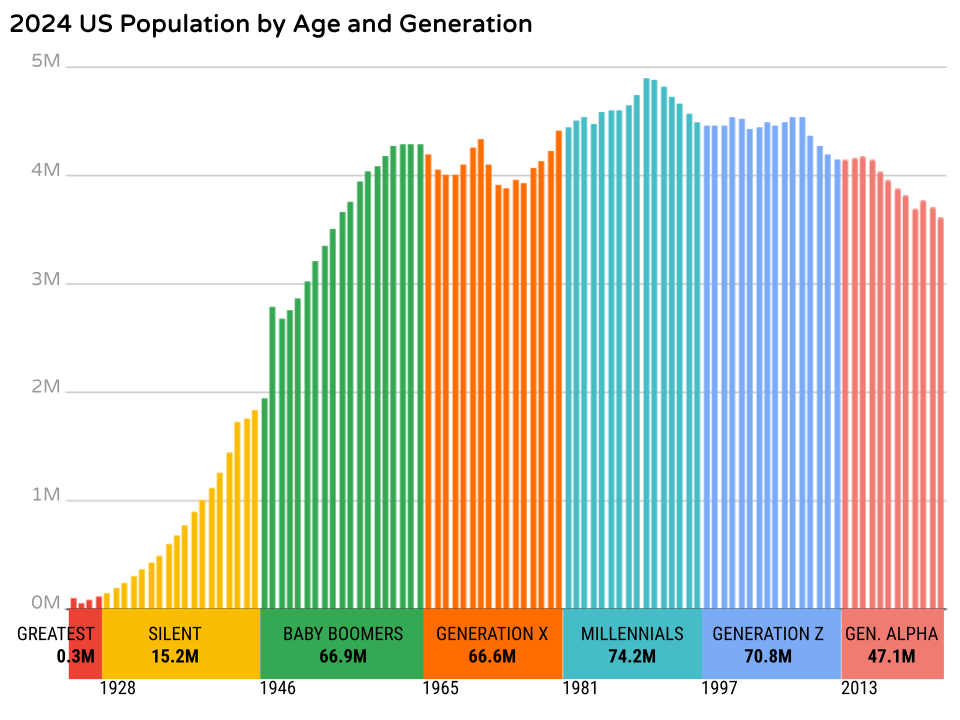
I’ve heard similar quandaries from clients before, and I suspect we’ll hear this question much more over the coming decades, as the ~67 million Baby Boomers continue to age.
But considering the number of uncertainties about these future inheritances, how do we adjust our financial plans today? Or do we simply carry on as if that inheritance doesn’t even exist?
What Could Possibly Change?
I think the best place to start this answer is by addressing the specific uncertainties surrounding inheritance.
Timing
This is the big one. Liz’s parents could pass away tomorrow…or live another 30 years. The timing clearly affects when she gets access. But it also affects how much the inheritance might grow, and what it will be worth in today’s dollars (due to inflation).
The timing also affects Liz’s own life stage. She might receive it while she’s working and accumulating. She might inherit it when the kids are still at home, or pre-college. Or perhaps not until she’s already retired and empty-nested.

Amount
$10 million today isn’t guaranteed to be $10 million later.
If most of their assets are in investments, the portfolio could rise or fall dramatically.
Liz’s parents may use their wealth for lifestyle, healthcare, long-term care, travel, philanthropy, or helping other family members.
Taxes matter too. Federal estate taxes, potential state estate/inheritance taxes, or income taxes on specific assets (such as IRAs) can reduce the inheritance. Today’s tax laws might change too, altering what Liz is currently assuming.
Medicaid and long-term care laws may affect what’s left for Liz, too.
Structure
How Liz inherits can vary widely. She could get it all at once. It may come in a trust, to be distributed over time or restricted by age, milestones, or the trustee’s discretion.
Family Changes
Families change and so do estate plans. What if Liz’s parents revise their wills or trusts to change amounts, beneficiaries, or conditions?
You may not want to think this way, but there will be situations where divorce, remarriage, or blended families could alter the distribution.
You won’t want to think this way, either, but estate disputes do occur, delaying and/or reducing the remaining inheritance.

“I Read Each and Every One”
That’s what someone wrote in this ⭐⭐⭐⭐⭐ podcast review…

My free weekly newsletter helps busy professionals and retirees avoid costly mistakes and grow lasting wealth through retirement.
Join 4000+ subscribers, 100% free.
Sign up here:
How Should We Incorporate Future Inheritance Into Our Financial Plan?
With these uncertainties in mind, how should we build our financial plan? Here’s what the Certified Financial Planner Board thinks. The basics are:
Hope for the inheritance. Don’t depend on it. Build flexibility into your plan. Treat it as a scenario to revisit, but not a cornerstone to rely on.
I agree with parts and disagree with others. But let’s explain it more, first.
CFP best practices emphasize basing recommendations on reasonable and supportable assumptions. When I think of a “supportable” inheritance, it means:
- There’s legal documentation (like a current estate plan),
- The heirs know the approximate structure and value, and
- It’s expected in a defined timeframe.

If the inheritance is uncertain, the professional best practice is to exclude it from the core financial plan. Instead, you model a “what if” scenario in the background.
I would wager that 99% of the time, the “defined timeframe” is where most heirs lack definition, and why most inheritances end up in the “what if” space. This is a conundrum, though. For many people, the question is not IF, but WHEN. To pretend the inheritance doesn’t exist, or to equate it to $0.00, seems simply absurd.
Planners then usually attempt to build a self-sufficient plan, ignoring the inheritance. If/when the inheritance arrives, it’s icing on the cake.
But there’s another problem. Liz, for example, is staring at a future inheritance that is ~4x larger than her FI number. That’s like 10 pounds of icing on a single cupcake. The “icing on the cake” analogy no longer holds…

That’s why, for larger or more certain inheritances, I would recommend modeling a few versions:
- Base case: No inheritance. Just to set the baseline. Even in situations where you’re damn sure the inheritance is coming, I think a baseline is important.
- Moderate case: The inheritance arrives later than ideal for your plan (which, hopefully, means a loved one is living a long life!), or the inheritance arrives smaller than expected.
- Upside case: The full foretold inheritance arrives sooner than expected.
I would recommend stress-testing each of these three scenarios for retirement readiness (assuming that’s your goal), tax optimization, estate impact, etc. Then, as part of revisiting your financial plan, you revisit your assumptions and rerun these cases.
We also need to plan for actually receiving the inheritance. Sudden wealth can be destabilizing in itself, but doubly so when it coincides with sudden loss. You need to plan ahead for what to do when the money arrives on your balance sheet. For example:
- Set emotional and financial priorities (“What do I want this money to do? What did they want me to do with this money?”)
- Revisit tax implications (step-up in basis, inherited IRAs, etc.)
- Do you now need to make your own estate plan changes?
Ignore an Inheritance? Even a Big One?
I want to revisit my two speed bumps from above.
- For many people, the question is not IF, but WHEN. To pretend the inheritance doesn’t exist, or to equate it to $0.00, seems simply absurd.
- For some people, the “icing” of an inheritance is WAY bigger than the “cake” of their own finances.
For these individuals, I believe certain aspects of the “financial planning best practices” are overly restrictive and unrealistic.

If you know you’re receiving an inheritance, you’ve seen the estate documents, your parents (or whoever) have given you a specific dollar amount and informed you how it could potentially change over the coming years, etc. etc., then I think it’s reasonable to build that inheritance (at least a portion of it) directly into your financial plan.
Yes, you’re taking a risk. What if the inheritance doesn’t pan out?
But by assuming the inheritance is $0.00 in your base financial plan, you’re taking a much BIGGER risk! You’re going to scrimp and save and throttle your lifestyle for years in a manner that, ultimately, won’t move the needle for you.
Look at Liz. Her houshold earns $200K per year. I bet Liz could seriously tighten her belt to increase her household savings by $20K to $40K per year. Over the next 10-15 years, assuming average market returns, those savings could easily be another $1M to fund her retirement!
…except that hypothetical $1M would be swamped out by the potential $9M+ her household will (likely) eventually inherit.
The scrimping and saving and belt-tightening will have a measurable adverse effect on Liz’s lifestyle for the next 15 years, but the $1M at the end of the rainbow won’t have a commensurate positive impact.

By assuming no inheritance, Liz risks extreme conservatism and (likely) suffers the consequences.
Now, I’m not saying Liz should go take a $9M mortgage on her dream lake home while assuming the inheritance will eventually help her repay it. I wouldn’t go that far.
But the $0.00 “best practice” does not suit all scenarios. Like much of financial planning, we must combine common sense with reasonable judgment.
Thank you for reading! Here are three quick notes for you:
First – If you enjoyed this article, join 1000’s of subscribers who read Jesse’s free weekly email, where he send you links to the smartest financial content I find online every week. 100% free, unsubscribe anytime.
Second – Jesse’s podcast “Personal Finance for Long-Term Investors” has grown ~10x over the past couple years, now helping ~20,000 people per month. Tune in and check it out.
Last – Jesse works full-time for a fiduciary wealth management firm in Upstate NY. Jesse and his colleagues help families solve the expensive problems he writes and podcasts about. Schedule a free call with Jesse to see if you’re a good fit for his practice.
We’ll talk to you soon!
You have probably already covered this, but if not I think it would be a good discussion to have from the other side. If you are leaving a large (8 figures?), or even modest (7 figures?), or smaller (6 figures?) inheritance what are best practices?
Our three children are all millennials. I suspect that finances are a big factor in their planning a family. I’d hate for them to limit family size and then discover that they didn’t have to.
For us instead of leaving each of them a low 7 figure amount many years from now, we are working to have a plan that can give them some expectations. We are aiming to die with zero (not including debt free property), but give while living in a steady and predictable way that allows them to make choices now without having to guess.
Strongly agree with Stephen! My wife and I, both Boomers, helped with our children’s home purchases and are fully funding our grandchildren’s college funds. We have also committed to paying for pre-k costs. Plus, and most importantly, we have told our kids the minimum they can expect to inherit, which will definitely occur before they reach retirement age. So now they can build their financial plans accordingly.
I’m sort of in this scenario. I love my parents and don’t want my financial plan to be predicted on their dying. So, what I did was include the inheritance in my plan but assumed they lived until 110. This allowed me to get over the psychological hurdle of being dependent on their death.
I’m sort of in this scenario. I love my parents and don’t want my financial plan to be predicted on their dying. So, what I did was include the inheritance in my plan but assumed they lived until 110. This allowed me to get over the psychological hurdle and feel self sufficient.
We have enough now to help our young adult children get established by maximizing their Roths for the next 10 years and gifting them money they can use freely for anything (which includes their future wedding should they get married). Let that give them financial peace and compound till kingdom come. When we receive our communicated inheritances (from my wife’s parents in their mid 80’s) from their 2 trusts (likely about $800K-$1.2M per) we can give generously, like described above, for any future grandchildren’s expenses, while living and giving generously to those in need, our church, our favorite mission organizations doing the heavy lifting.
Excellent! Thanks for writing in, Tom!