Don’t miss an episode of our podcast, Personal Finance for Long-Term Investors. Available on all podcast players.
Here’s the latest episode:
Sure, you’ve heard of Senior Citizen discounts. Today’s discount is the opposite.
Shout-out to reader / listener Seth who shared this opinion with me. I’ll paraphrase his thoughts a bit:
When it comes to Social Security claiming, you shouldn’t just discount future dollars using an expected return or time-value-of-money calculation. Instead, you should discount those dollars because the average 62-year-old is a LOT more vibrant than the average 70-year-old.
This is an interesting thought.
Should we consider claiming Social Security earlier to squeeze more life out of it?
Or, put another way, is there a subjective reason why $2000 per month at age 62 is more valuable than $3500 per month at age 70?
And is that subjective reason so powerful that it’s worth locking in those lower payments for life?
…so powerful that it overcomes the objective reasons to delay?
The Objective Baseline
The objective baseline strategy for Social Security is a well-worn discussion. I’ve discussed it at length.
But if we had to rehash the “basic” objective strategy for Social Security claiming, it would be
- Delaying pays. Claiming at 62 permanently cuts your benefit for life. It’s 30% less than if you claim at 67, 44% less than claiming at 70.
- Your health and longevity should drive the decision. The breakeven point for delaying is usually around age 80. If you’re in good health and your family tends to live long, delaying Social Security usually wins. If you have serious health concerns or really need the income now, claiming earlier can make sense.
- Married couples should plan together. When one spouse dies, the survivor keeps the larger of the two benefits. That makes delaying for the higher earner the most valuable move for many couples.
- Coordinate with taxes and your other savings. Up to 85% of your benefits can be taxable, depending on your other income. Many people draw from savings in their 60s as a “bridge” so they can delay Social Security. Those lower-income years can also be a good time for Roth conversions.
So with these clear “rules,” what’s the argument for claiming at age 62?
“Ability to Enjoy It”
In early life, we have health and time, but not much money.
In our middle years, we have more money and health, but not enough time.
As we age, we regain “free time” but start to lose our health.
That’s the simple version, at least.
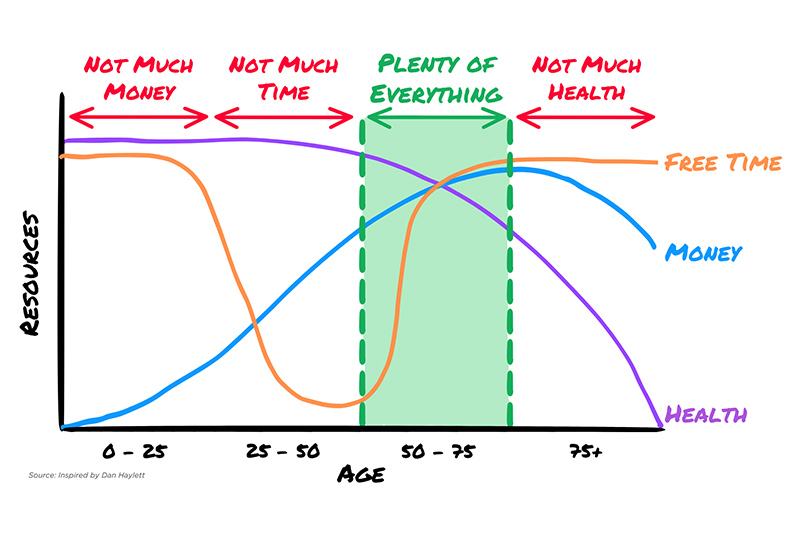
Today’s argument rests on that simple framework.
By the time you’re 70, will you need more money? Will your declining health even let you spend it?
The argument is that traditional, objective Social Security claiming strategies maximize numbers on a spreadsheet, but fall short of a life well-lived.
Whereas claiming early — intending to spend those extra dollars in the more vibrant years of retirement — help maximize the things that truly matter in life.
What say you, reader?
Thank you for reading! Here are three quick notes for you:
First – If you enjoyed this article, join 1000’s of subscribers who read Jesse’s free weekly email, where he send you links to the smartest financial content I find online every week. 100% free, unsubscribe anytime.
Second – Jesse’s podcast “Personal Finance for Long-Term Investors” has grown ~10x over the past couple years, now helping ~20,000 people per month. Tune in and check it out.
Last – Jesse works full-time for a fiduciary wealth management firm in Upstate NY. Jesse and his colleagues help families solve the expensive problems he writes and podcasts about. Schedule a free call with Jesse to see if you’re a good fit for his practice.
We’ll talk to you soon!
Good concept to think over. In a vacuum, assuming someone ONLY had SS income for the rest of their life or that was the strong majority of income (lets say SSI discounted back to WHENEVER the user start to claim is 75% of their newtworth…fill in your own discount rates and how long they claim…ei. life expectancy), then this is a very power exercise.
But if they have more savings/investments…they could simply live off those as you pointed out.
This assumes the person is rational. I would guess in most professional financial planners experiences, most people are not rational. I hear a lot of financial planners trying to talk clients into spending more in thier retired years.
In my opinion, it is going to land based on how you weight 2 priorities that take from each other. Optimizing lifetime enjoyment vs. optimizing for safety/legacy. I would guess extreme savers/optimizers WITH average life expectancies may see outsized utility in claiming earlier, as it could allow them the illogical comfort of spending more when they get the most joy from discretionary spend.
Married couples, those with strong family histories of longevity, those who sleep well at night drawring down or with market fluxuations, may not be as well served.
I personally also like a larger monthly payment for the top earning spouse OR waiting til 70 for most single for another non-financial reason. Its a little harder to ruin your finances.
Anedote here lol: Your long term financial plan has an intrinsic assumption you act mostly logically. What happens if your mental state/logic starts to decline? I just lost my 89 year old grandfather….super smart guy, most of his life was a great investor, have SSI, a pension and a 401k. In his mid-80s….he lost 300k in a single year, from his 401k trading a SINGLE stock. He went from his 30’s-early 80’s never putting more than 10% or so of his 401k in individual stocks collectively. The family only learned a year later, it wasn’t our business anyway. But, why would a deciplined investor do this? My best guess….older age caused him to not think as rationally as he once did. Life circumstance left him more willing to take gambles (he lost my grandmother when he was 80) could also play into this. I don’t know when my grandfather opted to start his SSI payments, BUT, had he lived off investments longer and got a larger SSI payments, he likely would have lost less in the markets in his older age.
So, while taking SSI earlier helps you enjoy a little more while discretionary spend provides the most joy, waiting helps you not mess things up as its spread out, incrimental cash flow vs. having access to a larger nest egg at any given moment.
Good post Jesse.
I love this discussion and also keep coming back to the point “personal finance” is personal. Maximizing the things that are truly important makes a lot of sense in a life with limiting factors. But the things that are truly important are different for everyone: maybe traveling the world in their 60s, or not risking running out of money late in life, or leaving something that impacts future generations, or dying with zero. To each their own. Perhaps self-awareness of what truly matters to us will help keep us from making decisions we regret.
The graph makes me want to focus on maximizing the green “plenty-of-everything” area. Saving money, retiring early, living as healthy a lifestyle as I possibly can!
MAXIMIZE THE GREEN!! Great goal!! Approaching my mid 60’s and thinking I have not achieved Maximum levels of utilization. Great wake up call. Good post Jesse!!
A person with good saving habits can benefit from claiming Social Security early. That guaranteed income is sweet until RMD’s come and forces your income into the 4th IRMMA, Obama’s Net Investment Income Tax and the 32% tax bracket. At this point every dollar pulled from the IRA gives the government a nearly 40% claim on your savings. Live in a nearly Socialist State like NY or CA and a rational person might ask why does the government take so much of my hard earned savings?