Don’t miss an episode of our podcast, Personal Finance for Long-Term Investors. Available on all podcast players.
Here’s the latest episode:
I was recently watching this video from Rob Berger.
The short summary of the video is that Rob discusses Jean Chatzky’s new book, The Forever Paycheck, and Rob specifically shares his opinions on annuities, and compares them to other fixed income options – one being a TIPS ladder.
I agree with Rob’s feelings. I’m not a big fan of annuities in this situation.
I wanted to add some mathematical reasoning, though. TIPS ladders are simply a better objective choice.
The Rate of Return Argument
We need to create an apples-to-apples comparison here.
Let’s imagine two identical soon-to-be retirees. They are 60 years old, and have $1M available to create fixed income with.
Retiree 1 builds a 30-years TIPS ladder. Retiree 2 buys a single-premium immediate annuity (one of the few types of annuities even worth considering, in my opinion).
TIPS Returns
Based on the current TIPS yield curve, the implied nominal return on a TIPS ladder is between 4.5% and 5.0% between Years 1-15, and then a implied return of 5.25% (or even a bit more) for most of years 16-30.
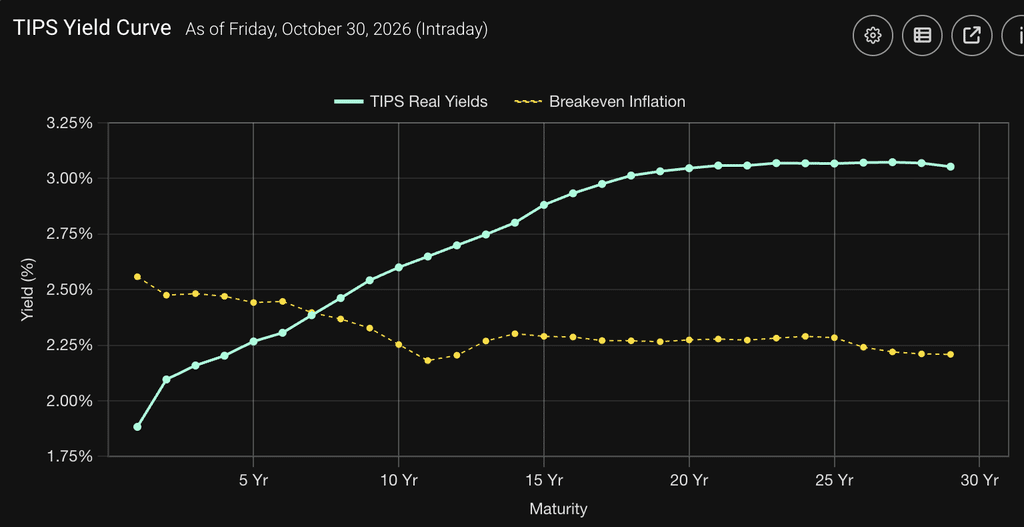
A simple way of thinking about it: if Retiree 1 dies at any time in this 30-year period, he can expect that he would have received a ~5% annualized return from his TIPS ladder, including a full return of the initial invested capital.
While the specific inflation rate over the next 30 years will affected Retiree 1’s returns, it has the potential to affect the returns in both directions (up or down). Thus, using the breakeven inflation number as part of the assumed returns makes sense.
What about an single premium immediate annuity?
SPIA Annuity “Returns”?
I compared some annuity payouts for Retiree 2, a 60-year-old male here in New York state. His likely payout for a $1M SPIA is $5,860 per month, or $70,320 per year, or 7.032%.
Vitally, this is not a rate of return. This is a payout rate.
The difference is that Retiree 2 has, essentially, “sacrificed” his initial $1M to purchase the SPIA. After, say, 5 years, Retiree 2 will have received ~$350,000 in payouts…but will still be $650,000 underwater due to the initial $1M purchase.
It will take ~14 years before Retiree 2 has received his initial $1M back. He only achieves a positive rate of return starting in Year 15. His long-term rates of return look like this:
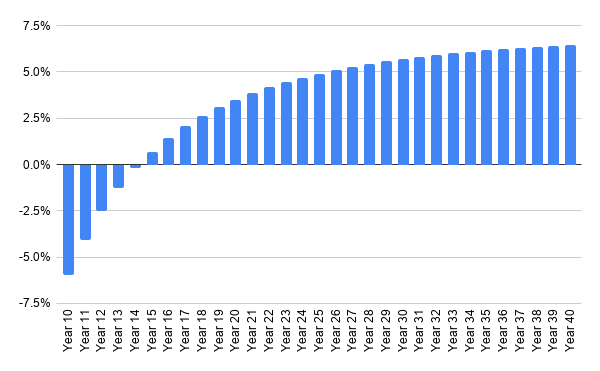
By Year 30, Retiree 2 has actually achieved a rate of return of ~5.7% per year. This is even better than the TIPS ladder return!
But we need to ask another important question…
Probability of Death
What are the odds that our retirees, both age 60 today, live to see age 70? Or age 80? Or age 90?
Should these probabilities affect the decision between a tips ladder and an annuity? I say yes.
The simple fact is that the TIPS ladder return is approximately stable (~5% per year) no matter when our retiree dies.
The annuity return, however, is meaningfully worse than 5% per year through the first 20 years, then achieves parity with the TIPS ladder by Years 25-28, and then appears better than the TIPS ladder for Years 28+.
What are the odds that Retiree 2 lives long enough to see his annuity outperform? It’s unlikely!
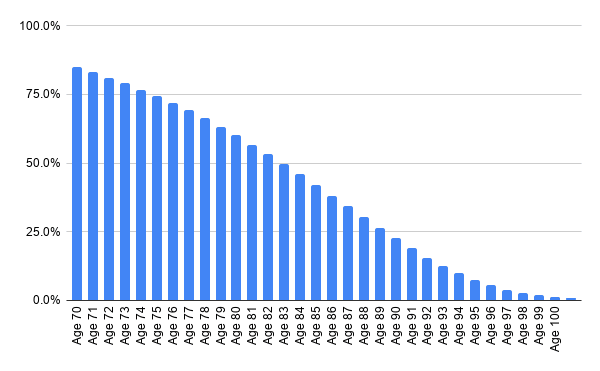
A 60-year-old American male has a ~50% chance of living past age 83 (Year 23), and a ~25% chance of living past age 89 (Year 29).
These facts lend themselves to a clean financial analysis. For the annuity payout, multiply each future annual payment by the probability that Retiree 2 is still living, and then calculate the rate of return based on those weighted/probabilistic cashflows.
Example: Year 30 of the annuity sees a $70,320 payout, but there’s only a ~19% chance that Retiree 2 is still alive to receive it. Thus, the weighted payout for this year = ~$13,400 (or, ~19% of $70,320).
The result of this full analysis isn’t appealing.
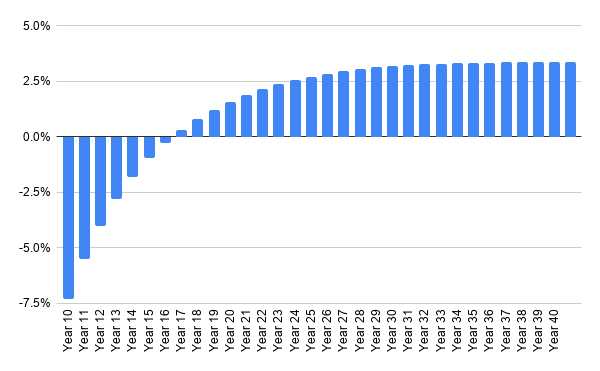
Viewed through this probabilistic (and thus, realistic) lens, Retiree 2’s expected return from his single-premium immediate annuity maximizes around ~3.5% per year.
Recall – the TIPS ladder’s return will be ~5% per year regardless of when Retiree 1 passes away.
When measured over decades, the difference between 5% per year and 3.5% per year is huge.
Do TIPS and Annuities Have Similar Risks?
Perhaps the final unanswered question in this analysis is whether TIPS and annuities have significantly different associated risks?
The conversation is fairly subjective. In my opinion, if one is riskier than the other, I think the annuity carries more risk. But let’s break it down, risk by risk.
Inflation: a clear winner here. TIPS are designed to protect against inflation. A nominal annuity has no inflation adjustment, and thus is fully vulnerable to the slings and arrows of inflation.
Flexibility: another clear winner. A TIPS ladder can be liquidated at any time. Whereas an annuity, once purchased, loses all future flexibility.
Credit: here we compare the credit risk of the U.S. government (which owes you interest and principal on your TIPS) against the credit risk of your preferred insurance company (who owes you annuity payments). Either failure would be a very low-odds event. But if we have to pick a winner here, I’m going with TIPS once again.
Longevity: what if you live past the 30 years of your TIPS ladder? While we can feel confident and comfortable with our assumed 5% returns for the first 30 years of the TIPS ladder, any further future returns are currently a black box. The annuity, on the other hand, is clearly defined forever (until death). Thus, the nod for better handling longevity risk clearly goes to the annuity.
Early death: …but the opposite side of the coin, an early death, clearly favors the TIPS ladder.
Interest rates: both of these tools are designed to be fairly insensitive to interest rate risk. That said, the market value of the TIPS ladder will be sensitive to interest rates in a way that simply does not apply to the annuity. Interest rate risk favors the annuity.
Tax drag: a TIPS ladder suffers worse tax drag than an annuity. The entire ladder is generating interest, even if you’re only living off of one rung at a time. And when inflation is higher than expected, the inflation adjustment of TIPS creates “phantom income” — taxable as ordinary income in the year it accrues, even though you don’t get access to that money until the bond actually matures. Annuities, on the other hand, are mostly returning your own capital to you, and thus our taxed favorably via an “exclusion ratio.”
Some pros, some cons. Perhaps too close to call.
But there’s certainly no risk so significant to outweigh the aforementioned difference in likely returns.
If the choice is between building a 30-year TIPS ladder and buying a single-premium immediate annuity, I see a clear reason to favor the TIPS ladder.
Thank you for reading! Here are three quick notes for you:
First – If you enjoyed this article, join 1000’s of subscribers who read Jesse’s free weekly email, where he send you links to the smartest financial content I find online every week. 100% free, unsubscribe anytime.
Second – Jesse’s podcast “Personal Finance for Long-Term Investors” has grown ~10x over the past couple years, now helping ~20,000 people per month. Tune in and check it out.
Last – Jesse works full-time for a fiduciary wealth management firm in Upstate NY. Jesse and his colleagues help families solve the expensive problems he writes and podcasts about. Schedule a free call with Jesse to see if you’re a good fit for his practice.
We’ll talk to you soon!
There is also a time consumption consideration that was not included with TIPS as a con right? Or are you able to set it up and be done?
Most annuities have an option for guaranteed payout over a number of years. Why not compare a TIPs ladder and an annuity with this option? The mortality issue is removed from the equation.
Your analysis is correct but I want to challenge the framing of this debate as either TIPS or annuities being the winner. As you pointed out, these two tools hedge different risks — TIPS hedge inflation and annuities hedge longevity.
For my retirement plan, that ended up meaning that my fixed income allocation actually contains both an income annuity and a TIPS ladder. I freely admit that if TIPS had higher yield last year when I bought an annuity I was (1) aware of but not fully appreciating the true negative power of inflation erosion (2) completely unaware that such a thing as TIPS existed or possibly I had heard of TIPS but didn’t have a clue about how they worked. So when I bought the annuity, I was thinking that product, combined with BND and VTIP, would make up my fixed income allocation throughout my retirement.
Fast forward to earlier this year when I was completing year one of my formal YouTube university degree in personal finance and retirement planning (backed up with plenty of actual research, a lot of back and forth with AI and even some human interaction with a flat fee, boglehead oriented advisor). I became fully aware of the power of TIPS and I was also cognizant of the unique opportunity presented by current yield on TIPS. If I had been aware of this opportunity back when I bought the annuity, I would have found it more attractive than the annuity for the same reasons you’ve described in this article. It’s likely that I’d today be sitting on either a longer ladder than my current 20-year ladder or I would have juiced up the level of income I’ll be getting during that 20-year time frame.
But that’s not how personal finance works. It can be a little messy when you’re just starting to learn and you’re trying to balance all the benefits and trade-offs of the many options available in retirement. Since I already understand that this messiness is a feature not a bug of investment and personal finance, I’m actually experiencing zero regret about the annuity purchase.
While I may have chosen differently under different circumstances; I’m now looking at a plan that includes a guaranteed income floor that amplifies the longevity and inflation hedges already provided by Social Security when I start that in about 6 years (I’m 59).
I now see these two vehicles as complementary, each one working hard to increase the strength and resilience of my retirement plan in their own way. Other diversifiers of risk management in my plan include my large stake in VT, which will grow largely untouched for the next 23 years, with that growth ultimately offering further protection against inflation and longevity, and a modest allocation to 3-year MYGA which is earning 6%, which offers some hedge against sequence of returns, with the MYGA proceeds offering optionality to be deployed in whatever direction will make sense at the end of the contract in 2029.
While I’m very confident in and proud of the plan I’ve created, I’m certain that a dividend investor would look sideways upon the choices I’ve made, as would a pure total return investor. That’s perfectly fine with me. I did what I personally needed to do to hedge all the risks that I deem important as well as I can, and the different parts of the plan are sized appropriately to reflect how much I value the mitigation of each of those risks. So on the personal side of personal finance, I’ve checked the boxes I wanted to check, and on the finance side, I’ve followed the research and data in my effort to maximize the objective strength of the plan.
Oh one more thing. I’ve noted that most finance and investing experts will only reference SPIAs and occasionally DIAs when discussing the pros and cons of income annuities because those two products are the most straightforward way to lock in lifetime income. I’d like to humbly suggest that this hyper focus on simplicity ignores a perfectly viable additional lifetime income option — the FIA with income rider. I understand why. FIAs are unnecessarily complex and the fees that are applied in the background of these contracts are consequential. But the part that some experts miss is the notion that this product’s only important characteristic is the level of income provided, and on that one metric alone, a FIA with income rider can sometimes rise above a SPIA or DIA when it comes time to compare the level of income each one can provide. It all depends on your age and your capacity to defer. A lot of times the SPIA/DIA route is superior, but sometimes it isn’t. I looked at each of these options when I was shopping for my annuity and for my circumstances, the FIA was the stronger choice at the time of purchase. One benefit of the FIA for my plan when compared to SPIAs and DIAs is the unique tax treatment of FIAs with income riders. The exclusion ratio doesn’t apply to FIAs. Instead, the return of principal constitutes the bulk of the income provided in the first decade or so of the contract, and for much of that time the income is mostly tax free and occasionally it’s completely tax free. That’s important because it means my net income is highest during my most vulnerable sequence of risk exposure. I didn’t consciously select the FIA with this aspect in mind. I honestly didn’t even understand exactly how taxation would work when I made the purchase, even though I absolutely should have exercised more due diligence on that issue. I’m just fortunate that it actually is a helpful not harmful aspect of my overall plan.
Overall, I recognize that my early retirement became viable due to multiple fortuitous tailwinds, including a job that literally quadrupled in salary over two decades, a 401k that correctly put me into a diverse portfolio that did its job without any agency on my part — I really had no idea what it was invested in or why — and of course there’s the incredible run of great market performance throughout my relatively brief accumulation phase the past couple of decades (I was a late bloomer, starting my career right around my 40th birthday).
Anyway, you’ve been one of my great YouTube professors this past year and a half or so and I’m grateful for that. I appreciate you doing a very balanced analysis of TIPS and annuities. There’s a lot of cyber noise around both these tools, and a lot of times the noise isn’t well grounded in the nuance that makes each of them attractive in their own way.
The TIPS ladder in a Roth would overcome the concern for any taxable income. I also considered an annuity in a Roth, however it is too much of a commitment for me. I am using TIPS and VBIL in my Roth as part of my 20% bond holdings, where the TIPS and VBIL. I like the ordinary income in the Roth and this is also part of my buffered assets. Any thoughts on this approach?